Elk and Bison
Why Withdrawing from Offshore Casinos Takes Longer Than Casinozoid Expected
Players who sign up with offshore casinos often arrive with reasonable expectations about how quickly they can access their winnings. Those expectations are frequently wrong — not because of fraud or bad faith, but because the mechanics of moving money across jurisdictions, through compliance departments, and via international payment networks are genuinely complex. Casinozoid, which tracks withdrawal experiences across dozens of licensed offshore operators, has documented a consistent pattern: actual processing times routinely exceed what operators advertise on their banking pages. Understanding why that gap exists requires looking at several distinct layers of the withdrawal process, each of which introduces its own delays.
Regulatory and Compliance Bottlenecks at the Operator Level
The most misunderstood source of delay is the Know Your Customer (KYC) verification process. Offshore casinos licensed in jurisdictions like Malta (MGA), Gibraltar, Curaçao, or the Isle of Man are required under their licensing conditions to verify player identity before releasing funds above certain thresholds. The Financial Action Task Force (FATF) recommendations, which most reputable licensing bodies adopted formally after the 2012 revision of their anti-money laundering guidelines, require operators to confirm identity, address, and in some cases the source of funds before large withdrawals are processed. This is not optional — operators who skip these checks risk losing their licenses.
In practice, this means a player who has deposited and wagered without issue can find their first significant withdrawal held for anywhere from 24 hours to several weeks while documents are reviewed. The delay is longer at offshore operators than at domestically regulated casinos in part because offshore compliance teams are often smaller relative to the player base, and because they may be operating across multiple time zones with limited staffing during evenings and weekends. A casino licensed in Curaçao, for example, may have its compliance team based in Eastern Europe, creating a situation where document submissions made on a Friday afternoon are not reviewed until Monday morning — a 72-hour delay before the process even begins.
Beyond initial KYC, enhanced due diligence (EDD) can trigger additional delays. If a withdrawal is flagged by the operator’s transaction monitoring system — because of its size, frequency, or deviation from a player’s established pattern — a compliance officer must manually review the account. This review can include requesting bank statements, payslips, or written explanations of gambling funds. Players who have never encountered this before are often surprised; they assumed that winning and requesting a payout was a simple transaction, not a process that could involve submitting personal financial documentation.
Payment Infrastructure and Cross-Border Processing Times
Even after a withdrawal clears internal compliance review, the funds still need to travel through payment infrastructure that is not designed with speed as its primary feature. Bank wire transfers from offshore jurisdictions to domestic bank accounts in countries like the United States, Canada, or Australia can take between three and seven business days under normal conditions. This is because international wire transfers typically route through correspondent banking networks — intermediary banks that process cross-border transactions on behalf of smaller institutions. Each correspondent bank in the chain may apply its own processing window and compliance screening.
The situation is further complicated by the fact that many mainstream banks in regulated markets have de-risked their relationships with gambling-related entities. Following regulatory pressure in the mid-2010s, several major US and UK banks restricted or blocked transactions identified as originating from gambling operators. This forced offshore casinos to use alternative payment processors, many of which route funds through multiple intermediary accounts before reaching the player. The result is a longer chain of custody for the money, with each link in the chain adding time.
E-wallet providers like Skrill and Neteller, which were originally seen as a solution to this problem, have themselves become subject to increased scrutiny. Both companies have tightened their merchant acceptance policies for gambling operators since 2019, and players in certain jurisdictions have found their e-wallet accounts limited or closed after repeated gambling-related transactions. Cryptocurrency withdrawals, which some offshore casinos now offer, can be faster in terms of blockchain confirmation times — typically under an hour for Bitcoin with sufficient confirmations — but players who then need to convert crypto to fiat currency face additional steps and their own processing delays at exchange platforms.
Resources that document real-world withdrawal timelines, such as www.casinozoid.org/how-do-get-money-out/, reflect how these payment infrastructure variables translate into actual player experiences across different operator types and withdrawal methods, providing a more grounded picture than what operators typically publish in their FAQ sections.
Pending Period Policies and Their Justifications
A withdrawal delay that is entirely within the operator’s control — and therefore more controversial — is the “pending period” or “pending time” built into casino software. This is a deliberate hold applied to approved withdrawals before they are released to the payment processor. Pending periods at offshore casinos typically range from 24 to 72 hours, though some operators impose holds of up to five business days. During this window, the withdrawal is technically approved but the funds have not moved.
Operators justify pending periods on two grounds. The first is fraud prevention: a brief hold allows the risk team to catch cases where an account has been compromised after a withdrawal request was made. The second justification is operational — batching withdrawals together reduces transaction costs when operators are paying per-transaction fees to payment processors. Both justifications have some merit, but the practical effect for players is an additional layer of waiting that has nothing to do with the payment network or regulatory compliance.
Casinozoid’s analysis of pending period policies across offshore operators found significant variation that does not correlate neatly with operator size or reputation. Some smaller operators with Curaçao licenses process withdrawals within hours; some larger MGA-licensed operators impose 48-hour pending periods as standard policy. This inconsistency makes it difficult for players to predict timelines based on licensing jurisdiction alone, which is one reason why operator-specific withdrawal reviews have become a meaningful resource for players doing due diligence before depositing.
Currency Conversion, Chargebacks, and the Reversal Window
Currency conversion introduces another variable that is rarely discussed in operator documentation. When a player deposits in one currency and the operator’s accounts are denominated in another, the withdrawal process involves a conversion step that may be handled by the operator, the payment processor, or the player’s bank — and each of these parties may apply different exchange rates and processing times. A player in Canada withdrawing CAD from an operator that holds accounts in EUR may find that the actual amount received differs slightly from what was shown at the time of request, and that the conversion itself added half a business day to the processing timeline.
The reversal window is a less commonly known factor. Many offshore casinos allow players to cancel a pending withdrawal and return the funds to their casino balance — a feature that exists partly for genuine player convenience and partly because it reduces the operator’s payout volume. Some operators have been criticized for making the reversal button prominent in the cashier interface, which can lead to impulsive cancellations. From a processing standpoint, if a player cancels and then resubmits a withdrawal, the entire compliance and pending period process restarts, which can effectively double the total wait time.
There is also the question of chargeback risk management. Payment processors that work with offshore gambling operators are acutely aware that gambling transactions have higher chargeback rates than most other merchant categories. Visa and Mastercard’s merchant category code for gambling (MCC 7995) carries specific rules around dispute resolution, and processors often impose holding periods on operator settlements to maintain a reserve against potential chargebacks. This holding at the processor level can delay the moment funds become available to transfer to the player, even after the operator has technically released them.
The cumulative effect of these layers — KYC review, enhanced due diligence, pending periods, correspondent banking chains, currency conversion, and processor holding reserves — is that a withdrawal which a player expects to complete in one to two business days can realistically take five to ten business days even when everything proceeds without complications. Casinozoid’s documentation of this gap between advertised and actual timelines is not an indictment of offshore operators as a category; many operate in good faith within constraints they did not design and cannot unilaterally eliminate. It is, however, a realistic picture of what players should anticipate when they choose to play at offshore-licensed platforms rather than domestically regulated ones, where tighter regulatory oversight tends to enforce faster and more predictable payout timelines.
Elk and Bison Prairie
Embark on a timeless journey through the Elk & Bison Prairie, where the spirit of the untamed frontier comes to life. Traverse the rolling landscapes where herds of majestic American Bison and graceful Elk roam free, just as they did over two centuries ago.
This living sanctuary is not just a drive—it’s a passage through the history of western Kentucky and Tennessee. Located just north of the Golden Pond Visitor Center and Observatory alongside the Woodlands Trace National Scenic Byway, the Elk & Bison Prairie stands as a testament to nature’s resilience and beauty. Come witness the grandeur of a bygone era, right here in the heart of Land Between The Lakes.
Contact Us About Elk & Bison Prairie
Phone
(800) 525-7077
Group bookings
(270) 924-2020
Address
Elk & Bison Prairie Road
Golden Pond, KY 42211
Hours
Year-round | 7 days a week dawn to dusk
General Admission
$5 per automobile
(No pedestrians, motorcycles, bicycles, etc., allowed for safety reasons.)
Purchase one-time entry at the cash/credit machine at the Prairie entrance.
Entry cards also available at Golden Pond Visitor Center, Welcome Stations, or any day-use facility.
3 entry cards – $10
5 entry cards – $15
Buses/Commercial Vans – $.50 per passenger.

Title

Title

Title

Title

Title

Title

Title

Title
Truly Unique
Drive through the Elk & Bison Prairie, a sprawling 700-acre habitat that echoes the untouched Kentucky wilderness of yesteryear. Here, elk and bison roam free as you make the journey along a 3.5-mile loop, be captivated by the symphony of wildlife that calls this prairie home.
Wild turkeys, a variety of birds, small game, butterflies, and prairie mammals find sanctuary in the Elk & Bison Prairie. This is an immersive experience into the heart of Kentucky’s natural heritage, a must-see destination for every nature enthusiast and wildlife adventurer.
How to Get Here
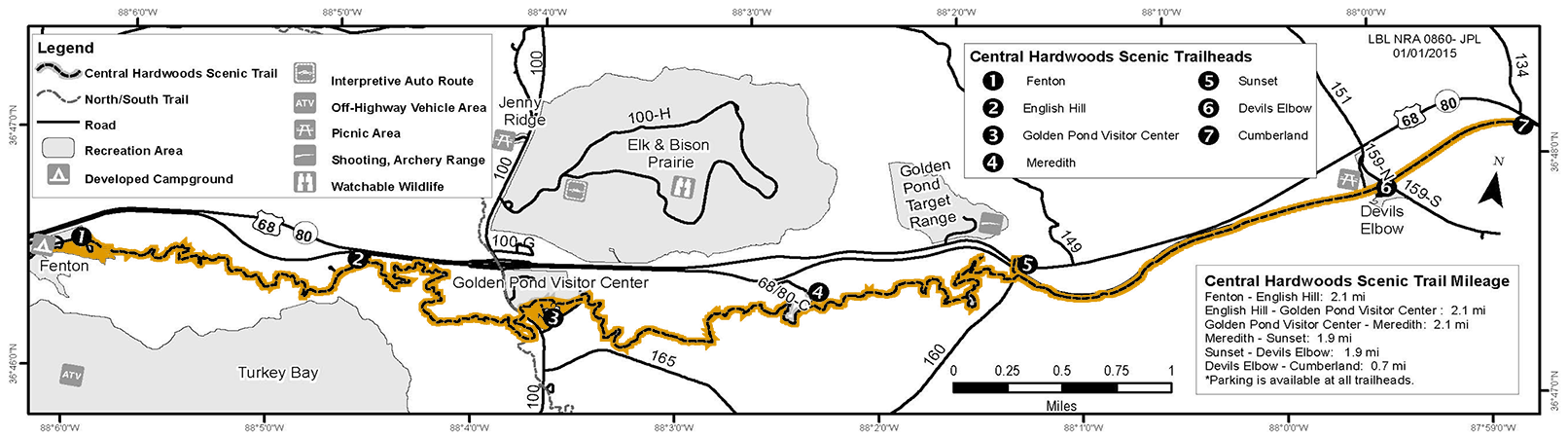
The Elk & Bison Prairie is located just north of the Golden Pond Visitor Center and Observatory along side the Woodlands Trace National Scenic Byway and north of the US 68/KY 80 east/west route across LBL.